The Institutional Case for Zcash
Cypherpunk Technologies, Grayscale, Reliance Global, the Winklevoss twins, Arthur Hayes. The first wave of institutional positioning in Zcash has begun. Here is the thesis behind the moves, the structural reason Zcash works for institutions where Monero cannot, and the risks worth taking seriously.
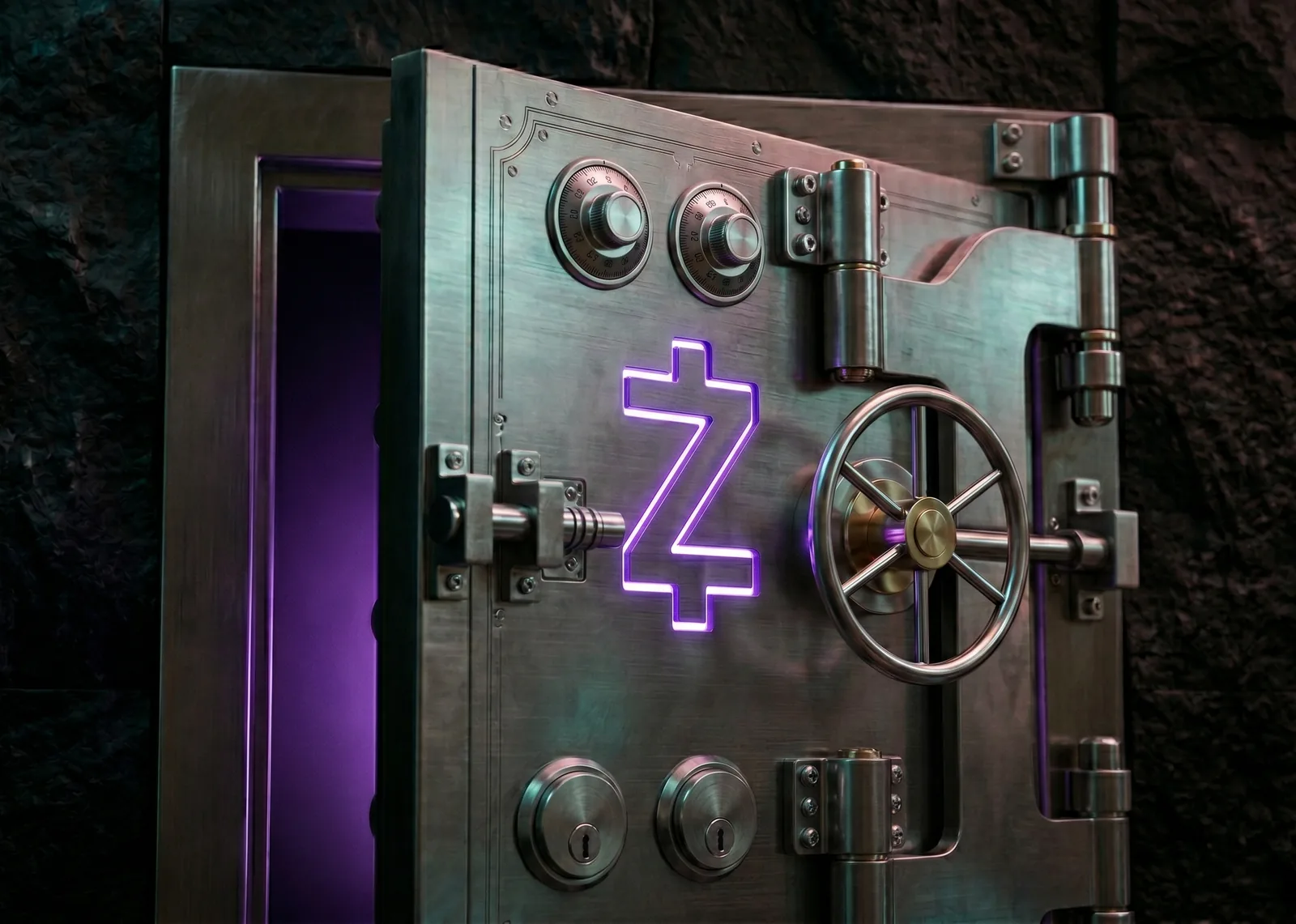
- Bitcoin's transparent ledger has become a structural problem for institutions, not just a curiosity for activists
- Most privacy coins solve privacy by removing the ability to prove holdings to anyone, which makes them institutionally untouchable
- Zcash is the only major privacy asset with selective disclosure: private by default to the public, provable on demand to your auditor or regulator
- The first wave of public-company treasuries, ETF filings, and named investor positions has begun, with most of the institutional cohort still on the sidelines
Why this matters now
In November 2025, a Nasdaq-listed biotech company called Leap Therapeutics changed its name to Cypherpunk Technologies, took on $58.88 million in private funding led by Winklevoss Capital, and used $50 million of it to buy 203,775 ZEC. By the end of the year it had crossed 290,000 ZEC, roughly 1.76 percent of all the Zcash in circulation, with a publicly stated goal of accumulating 5 percent of the entire supply.
The story did not begin with Cypherpunk and it will not end with it. Two weeks after Cypherpunk's launch, Grayscale filed an S-3 with the SEC to convert its existing Zcash Trust into the first spot ZEC ETF on NYSE Arca. Reliance Global Group, another Nasdaq-listed firm, exited its Bitcoin, Ethereum, and Solana positions entirely and reallocated to ZEC, citing the asset's compliance-ready privacy. Viewing key infrastructure has matured to the point where audited disclosure is a one-tap operation in modern wallets. The base rate of institutional interest in privacy as a category is changing.
This piece is for the people deciding whether to participate. Treasurers, fund managers, financial advisors, sophisticated retail. The thesis is straightforward: Zcash is the only privacy-preserving cryptocurrency that institutions can defensibly hold, and the market has not finished pricing that fact in.
The institutional privacy paradox
Privacy is supposed to be the cypherpunk concern, the activist concern, the thing you care about if you are worried about the state. It is also, quietly, the thing that keeps central banks holding gold instead of Bitcoin.
That is the gap Chamath Palihapitiya named on the People by WTF podcast in March 2026. His argument was that Bitcoin lacks two properties central banks require: fungibility and privacy. The transparent ledger that makes Bitcoin trust-minimized for retail also makes it operationally unworkable for sovereign reserves. Palihapitiya is a longtime Bitcoin advocate; he was buying near $80. The argument is not that Bitcoin failed but that it has a ceiling, and the ceiling is set by the same property that defined the asset. He did not name Zcash. He described the gap that Zcash is built to fill.
The institutional version of the privacy problem looks different from the activist version. Institutions do not worry about being doxxed by their neighbors. They worry about three concrete operational issues:
Front-running. A pension fund accumulating a meaningful position in any asset on a public ledger telegraphs its intent to every front-running bot watching the mempool. The cost of that visibility shows up as worse fills, market impact, and MEV extraction by sophisticated actors who can see the trade coming.
For a treasury accumulating one or two percent of a network's supply over a multi-year horizon, the cumulative cost of being readable on-chain compounds across every fill. It is the same reason large equity buyers route through dark pools rather than printing every bid on a public exchange.
Competitive intelligence. A corporate treasury that holds Bitcoin holds it in addresses that, eventually, get clustered and identified by chain analytics firms. Once those addresses are known, every flow becomes intelligence for competitors, journalists, and short sellers. Equity markets accept quarterly disclosure. They do not accept continuous public broadcast of every transaction.
Counterparty exposure on disclosure. When an institution discloses its holdings to its LPs, board, or auditor, it wants to disclose to those people specifically. Not to the entire internet. A transparent ledger removes the option to control who sees what.
The natural response to all three problems is privacy. The unnatural response, which most privacy systems force on you, is to give up the ability to prove anything to anyone. That tradeoff is what makes Monero and most other privacy coins institutionally unworkable. You cannot run an audited fund on an asset where you have no way to prove to your auditor what you hold.
What Zcash actually does differently
Zcash solves the institutional version of the privacy problem with one technical decision: selective disclosure. The same wallet that hides a balance from chain analytics can produce, on demand, a read-only credential that lets an auditor verify exactly what is held. The credential is per-counterparty. The privacy default holds for everyone you have not handed one to.
The technology underneath is zk-SNARKs, the cryptographic proofs Zcash pioneered in 2016 and that now underpin a substantial fraction of Ethereum scaling work. The relevant property for an institutional reader is not the math. It is the operational outcome:
- An institution holding shielded ZEC is invisible to chain analytics, front-running bots, and competitor intelligence operations
- The same institution can prove to auditors, tax authorities, and LPs exactly what it holds and what it has transacted, simply by sharing a viewing key
- The disclosure is voluntary, granular (you choose which counterparty gets which scope), and irrevocable only in the sense that information once shared cannot be unshared. The wallet itself remains private to everyone you have not chosen to disclose to
This is the property that makes Zcash institutionally viable and Monero institutionally unworkable. The gap between an asset a regulated fund can hold and an asset it cannot runs through that single design choice.
Who has already moved
The names matter because they signal what kind of capital is willing to be public about a position. The full picture is held privately, by definition, in the shielded pool that has grown from roughly 18 percent of supply in October 2025 to more than 27 percent by mid-November and continues to climb. What follows is what is observable above the surface.
Cypherpunk Technologies (Nasdaq: CYPH)
Rebranded from biotech firm Leap Therapeutics in November 2025 to operate exclusively as a ZEC treasury vehicle. Trades on Nasdaq under CYPH. Backed by Winklevoss Capital. The company has been clear that 5 percent is the floor of its ambition, not the ceiling. Tracked on its dedicated page.
Grayscale Zcash Trust
An existing trust structure that has held ZEC for institutional investors since 2017, currently holding approximately 2.4 percent of the network's supply. In November 2025, Grayscale filed an S-3 with the SEC to convert the trust into a spot ETF listed on NYSE Arca under the ticker ZCSH. The filing is the first attempt by any issuer to bring a Zcash-backed ETF to a national securities exchange. Tracked on its dedicated page.
EZRA (Nasdaq: EZRA)
Formerly Reliance Global Group, an insurance technology firm that, in late 2025, exited its positions in Bitcoin, Ethereum, and Solana to reallocate the proceeds entirely into ZEC. Disclosed holdings exceed 233,000 ZEC. The company cited the asset's combination of optional privacy with selective disclosure as decisive. Tracked on its dedicated page.
Tyler Winklevoss (co-founder, Gemini)
Articulated the digital-gold-versus-digital-cash framing quoted above and led Winklevoss Capital's funding for Cypherpunk Technologies. He and Cameron have separately donated to Shielded Labs, the Swiss organization developing core Zcash protocol upgrades, signaling a position that goes beyond a treasury bet into protocol-level support.
Cameron Winklevoss
Connected the privacy thesis to the longer arc: investors bullish on AI and quantum computing should also be positive on Zcash, on the grounds that both trends accelerate the demand for cryptographic protections that older transparent ledgers cannot provide.
Arthur Hayes (co-founder, BitMEX)
Disclosed publicly that ZEC is his second-largest position after Bitcoin and instructed his readers: "If you hold $ZEC on a CEX, withdraw it to a self-custodial wallet and shield it." The instruction is specifically about removing tokens from exchange custody and into the shielded pool, where they sit outside the readily tradable float.
Naval Ravikant (co-founder, AngelList)
Posted to X in October 2025 that "Bitcoin is insurance against fiat. Zcash is insurance against Bitcoin," in a single ten-word post that has since been quoted across the institutional positioning of the asset. Disclosure context the institutional reader should know: Naval was an early investor in the Electric Coin Company in 2015 and has served on the Zcash Foundation board. The position is less of a contemporary endorsement than a long-running thesis from someone with informed exposure to the protocol.
Why now and not in 2018
Zcash launched in October 2016. The technology has been available for almost a decade. The institutional thesis was not viable then. Three things have changed since.
Regulatory clarity in the United States, relative to alternatives. Major US-licensed exchanges including Kraken and Gemini continue to support ZEC, with selective disclosure cited as the feature that distinguishes Zcash from privacy assets that have been delisted or restricted. Monero has been removed from many of the same exchanges. Zcash has not. The regulatory window is open in the United States for the only privacy asset with the audit-friendly architecture institutions require. In April 2026 Robinhood Crypto added spot ZEC trading nationwide including in New York, the first major US retail brokerage to relist Zcash since the post-2023 delisting wave. We track current status across 95 jurisdictions as conditions evolve.
Viewing key infrastructure has matured. In 2018, exporting a viewing key from a Zcash wallet was a command-line operation. Tax software did not import them. Auditors had no workflow for them. Today, modern wallets like Zashi let you export a viewing key with one tap, and tax tools like CoinLedger import them natively. The disclosure side of selective disclosure has caught up with the privacy side. An institution can run its compliance workflow without leaving the privacy layer. See our guide to viewing keys for the operational detail.
The surveillance environment has changed. The argument that financial privacy is a niche concern was easier to make in 2018 than it is in 2026. Chain analytics has industrialized. CBDC pilots are in production in multiple jurisdictions. AI systems trained on public ledger data extract patterns no human analyst could surface ten years ago. The same trends that pull institutional capital toward AI-themed equities also raise the cost of holding wealth on a fully transparent ledger.
The honest risk section
An institutional thesis without a risk section is sales material. Here are the risks worth taking seriously.
Liquidity
ZEC is materially less liquid than Bitcoin or Ethereum. Position sizing matters. A treasury accumulating over months and quarters operates inside this constraint comfortably. A trader expecting to enter and exit a large position on a single day will pay for it.
Regulatory swing risk outside the United States
The European Union's Markets in Crypto-Assets framework has been the most public source of pressure on privacy-preserving assets in regulated EU venues. Implementation continues to evolve. US-based holders are insulated from this risk; institutions with European operations are not. Our jurisdiction guides track current status as it changes.
Exchange concentration risk
If a major US exchange were to delist ZEC, the on-ramp picture would tighten significantly even though the protocol itself is unaffected. The resilience case is that selective disclosure is exactly the property exchanges need to keep ZEC listed under existing AML frameworks. The pessimistic case is that political pressure can override technical adequacy. Both can be true.
Protocol governance
In January 2026, the entire development team at the Electric Coin Company resigned over disagreements with the nonprofit board overseeing the company. Independent organizations like Shielded Labs continue protocol work, and the Winklevoss twins have donated to support that effort. The transition is real and worth monitoring. The protocol has been through governance changes before and the network has continued to function.
The cypherpunk-versus-VC critique
A long-running argument in privacy-coin circles is that Zcash, having been funded by venture capital and structured to comply with regulators from day one, is not "really" cypherpunk in the way Bitcoin or Monero are. The criticism is intellectually honest and the institutional reader should be aware of it. Compliance-readiness is precisely what makes the asset holdable inside a regulated structure. The same property is a flaw to a purist and a prerequisite to a pension fund.
What to watch
The signals worth monitoring are observable and largely public:
The size of the shielded pool as a percentage of total supply. Continued growth indicates the network's privacy properties are strengthening, which strengthens the institutional case reflexively. Our on-chain dashboard tracks this in real time.
SEC progression on the Grayscale ETF filing. Approval would open access to RIA-managed accounts and 401(k) options that currently cannot hold spot crypto. Denial or extended delay would limit the institutional flow that ETF approval normally unlocks.
New treasury company disclosures. Cypherpunk Technologies is the first. The pattern after Bitcoin treasuries went mainstream was that the second and third announcements created the category, not the first. Our treasuries page tracks new entrants as they file.
The halving cycle. Zcash inherits Bitcoin's monetary discipline: a 21 million hard cap and a halving roughly every four years that cuts new issuance in half. The supply mechanics that powered Bitcoin's institutional adoption apply identically to ZEC, on an offset schedule.
The closing frame
The institutional case for Zcash is best read as a positioning observation rather than a price prediction. Trillions of dollars in declared crypto assets currently sit on fully transparent ledgers that were designed before chain analytics was an industry, before AI could extract patterns from on-chain data, and before central bank digital currencies became a near-term policy question. The institutional response to every one of those changes will be the same: demand a privacy-preserving alternative that can still be audited.
Of the assets that exist today, exactly one fits that description. The first wave of treasuries, ETF filings, and named positions has begun. Most of the institutional cohort has not yet decided. That is the window.
For the philosophical case for why privacy in money matters in the first place, see our companion piece, Zcash: Bitcoin's Second Chapter. For the technical detail on how selective disclosure actually works in a modern wallet, see our viewing keys guide. For the comparison against Monero on the institutional criteria specifically, see Zcash vs Monero.
Common questions
Why Zcash and not Monero for institutional exposure?
Monero has stronger default privacy in the sense that every transaction is private with no opt-out. The cost of that design is that you cannot prove your holdings to an auditor, regulator, or LP. Zcash's selective disclosure architecture lets a holder stay private to the public while producing a read-only credential (a viewing key) that lets a specific counterparty verify exactly what is held. For an institution that needs to be auditable, Zcash is workable and Monero is not. This is also why Monero has been delisted from many regulated exchanges where Zcash continues to trade.
What is selective disclosure in plain language?
Selective disclosure means the holder of a Zcash wallet can choose, on a per-counterparty basis, who can see their transaction history. The default is privacy from everyone. Sharing a viewing key gives the recipient read-only access to the wallet's shielded transactions. The recipient cannot move funds. They can only verify what is there. Tax preparers, auditors, and regulators all use this mechanism. The wallet itself remains private to everyone the holder has not chosen to disclose to.
Has any major institution actually disclosed a Zcash position?
Yes. Cypherpunk Technologies (Nasdaq: CYPH) is a publicly listed digital asset treasury company specifically built around ZEC, with a stated 5 percent supply target and disclosed accumulation crossing 290,000 ZEC by the end of 2025. EZRA (Nasdaq: EZRA), formerly Reliance Global Group, reallocated its entire crypto treasury into ZEC in late 2025, with disclosed holdings exceeding 233,000 ZEC. Grayscale's Zcash Trust (ZCSH) has held ZEC for institutional investors since 2017 and filed an S-3 with the SEC in November 2025 to convert into a spot ETF on NYSE Arca. Beyond named entities, the size of the shielded pool has grown substantially, which by design makes individual institutional positions invisible.
What is the regulatory risk if I hold ZEC in the United States?
ZEC continues to trade on major US-licensed exchanges including Kraken and Gemini, with selective disclosure cited as the feature that distinguishes Zcash from privacy assets that have faced delisting. The asset is not banned at the federal level. Tax treatment follows standard cryptocurrency rules. Holders should consult their own tax preparer; tools like CoinLedger import Zcash viewing keys directly. Outside the United States, the European Union's Markets in Crypto-Assets framework continues to evolve and may affect EU venue access. We track jurisdiction-by-jurisdiction status as it changes.
What about the criticism that Zcash is too compliance-friendly to be 'real' crypto?
The criticism is intellectually honest and worth acknowledging. Zcash was venture-funded and structured to comply with regulators from inception, which is a real philosophical departure from Bitcoin's anonymous launch. From a cypherpunk-purist standpoint, that is a flaw. From an institutional standpoint, it is precisely the feature that makes the asset holdable inside a regulated structure. The two positions are not contradictory. They reflect different priorities. An institutional thesis necessarily values the property that makes the asset workable inside existing financial infrastructure, while acknowledging that other privacy assets exist for users with different priorities.