The Privacy Stack: What Your Privacy Coins Don't Protect
Privacy coins do real work at the blockchain layer. That work stops at the chain. This guide covers the four layers that sit outside coin privacy (connection, identity, credentials, custody), and recommends a specific tool for each.
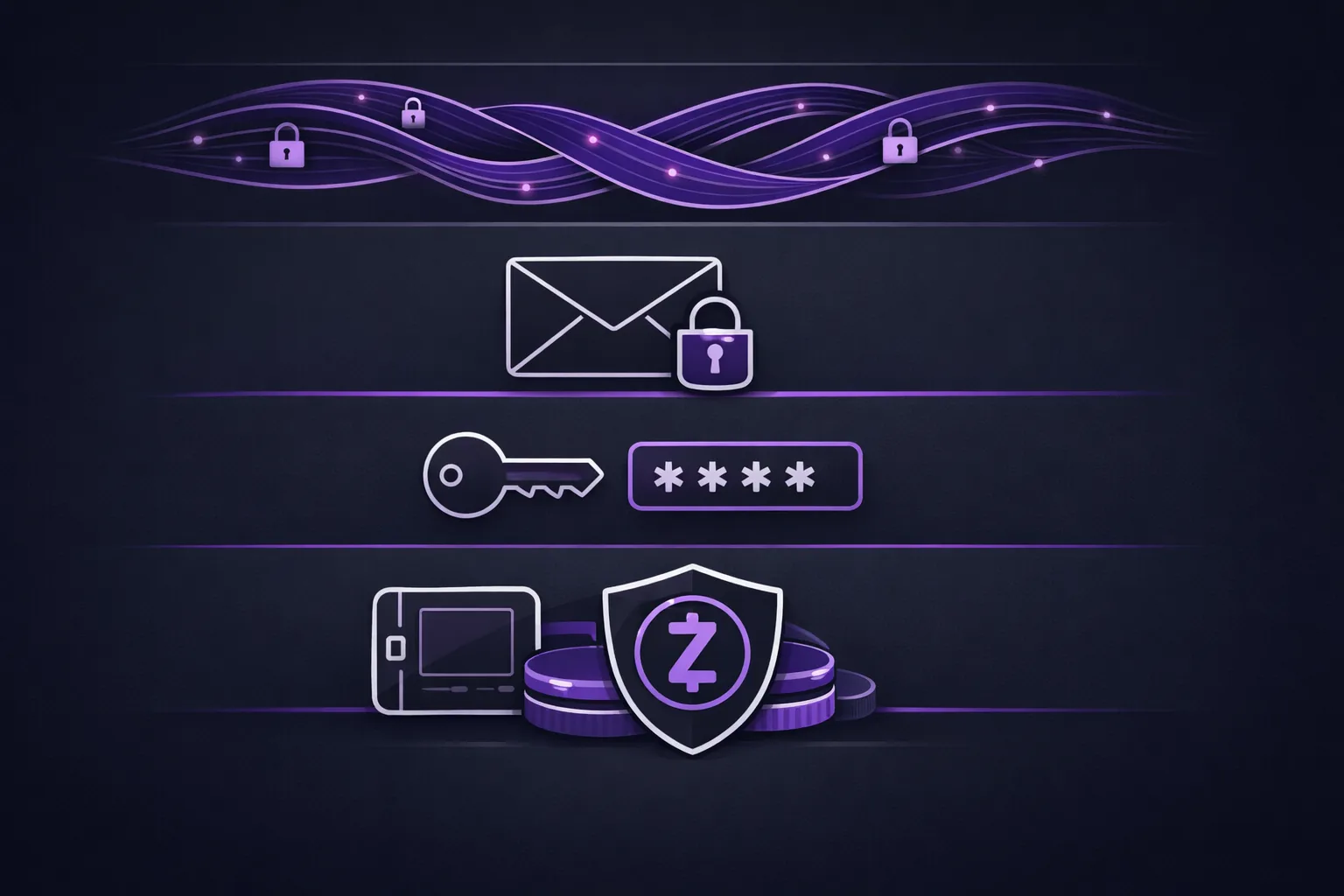
- Privacy coins protect transactions on-chain, but not the connection, identity, credentials, or device around them
- Four-layer privacy stack: VPN (Proton VPN), encrypted email (Proton Mail), password manager (Proton Pass), hardware wallet (Ledger for shielded ZEC, or Trezor for fully open-source firmware)
- Proton is recommended across three of four layers because its Swiss jurisdiction, open-source clients, audited encryption, and non-profit ownership meet a consistent bar
- The stack does not remove KYC'd exchange records, on-chain transparent transactions, or metadata that can be legally compelled
Start with the coins
You chose Zcash or Monero because you care about financial privacy at the blockchain layer. That's the right starting point. Shielded ZEC transactions use zk-SNARKs (Zero-Knowledge Succinct Non-Interactive Arguments of Knowledge) to hide sender, receiver, and amount. Monero transactions obscure the same three fields by default using ring signatures, stealth addresses, and RingCT. On-chain, both coins do real work that Bitcoin does not.
That work stops at the chain. Everything before and around a transaction sits outside what coin privacy protects. Your IP address when you visit the exchange. The email address tied to your account. The password you reused on five other services. The phone or laptop holding your wallet. Those are separate layers with separate tools.
There are other angles to privacy beyond finance: messaging, browsing habits, identity fragmentation, operational security against physical threats. This guide stays narrow. It covers the four layers that matter specifically for holding and transacting privacy coins, and it recommends a specific tool for each.
The stack at a glance
| Layer | What it covers | What coin privacy doesn't fix | Recommendation |
|---|---|---|---|
| Connection | Your IP address, DNS logs | Your ISP sees every site you visit before you ever open a wallet | Proton VPN > |
| Identity | The email on your exchange account | KYC ties your real identity to a permanent email address | Proton Mail > |
| Credentials | Passwords, 2FA codes | One reused password can cascade into a full account takeover | Proton Pass > |
| Custody | Private keys | A compromised device is a compromised wallet | Ledger >Trezor for open-source firmware |
Why Proton for three of the four layers
The internet has hundreds of VPN reviews and password manager comparisons. This site is not one of them. We recommend Proton across the connection, identity, and credentials layers because it is the only integrated privacy suite that meets our bar on all of them, and because the reasons it meets that bar are independently verifiable.
Swiss jurisdiction. Proton is headquartered in Switzerland, outside the Five Eyes and Fourteen Eyes intelligence-sharing agreements. Swiss privacy law is among the strongest in the world and requires a court order before any user data can be disclosed. Even then, the encryption architecture means there is less to disclose than at US or UK-based competitors.
Zero-access encryption by default. Proton Mail, Pass, and Drive use end-to-end encryption where even Proton cannot read the content. VPN traffic is not logged. This is not a trust-us claim; it has been tested in court. Swiss authorities have compelled Proton to disclose user data on rare occasions, and what Proton could disclose was limited to metadata (login timestamps, IPs where logging was legally required), not content.
Open source and audited. All Proton clients are open source. The company publishes independent security audits of its apps and infrastructure. You do not have to trust Proton's claims; you can inspect the code and read the audit reports.
Non-profit ownership. Proton's primary shareholder is the non-profit Proton Foundation. That matters because privacy companies that take venture capital are eventually pressured to monetize user data. Proton's ownership structure removes that pressure at the corporate level.
One account, one bill. Proton Unlimited bundles VPN, Mail, Pass, Drive, and Calendar under a single subscription. For users assembling a privacy stack from scratch, that reduces both friction and cost relative to buying each tool separately from different vendors.
Connection: what your ISP sees
What: Your internet service provider logs every domain you visit. Those logs are retained, subpoenable, and in many jurisdictions sold to data brokers who aggregate them into behavioral profiles.
Why it matters: Every visit to an exchange, a swap service, a wallet download page, or a research site like this one is visible at the network layer. Coin privacy does not touch this. A shielded ZEC transaction on-chain tells nobody anything, but your ISP's log already shows you were browsing privacy-coin content five minutes before.
How: A VPN routes your traffic through encrypted tunnels. Your ISP sees that you are connected to a VPN provider, not what sites you are actually visiting. The VPN provider's logging policy then determines what record remains. Proton VPN's no-logs policy has been independently audited and tested in Swiss courts. Clients are open source across Windows, macOS, Linux, iOS, and Android.
Encrypt your connection
Route your traffic through Swiss-based, no-logs VPN servers. Independently audited, open-source clients.
Identity: the email behind every account
What: Every exchange account, wallet backup, and crypto service signup ties a real email address to your activity. That email is the persistent identifier that follows you across data breaches, subpoenas, and aggregation services.
Why it matters: When an exchange is breached (and they are, regularly), the leaked data typically includes email addresses tied to KYC'd identities and transaction histories. If the email on your Coinbase account is the same one you use for LinkedIn, your name, employer, and crypto activity are now correlatable by anyone who buys the breach data. Using your primary email for crypto concentrates risk at the identity layer.
How: A dedicated encrypted email account for crypto use isolates your financial activity from the rest of your digital identity. Proton Mail uses end-to-end encryption with zero-access architecture, meaning Proton itself cannot read your messages. Recovery addresses and phone numbers are optional, so the account can be as isolated as you want it. Custom domains are supported on paid tiers for readers who want to own the email address itself.
Isolate your crypto identity
End-to-end encrypted email with zero-access encryption. A dedicated account for crypto use keeps financial activity separate from the rest of your digital footprint.
Credentials: the cascade problem
What: Most people reuse passwords across services. When one service is breached, the credentials get tried against every other known service in what is called credential stuffing. For crypto users, this turns a single breach at an unrelated site into a full exchange takeover.
Why it matters: The 2024 Ledger phishing wave, the repeated Coinbase support impersonation attempts, and the long tail of SIM-swap attacks all rely on the same assumption: that an attacker who obtains your email plus a password from a previous breach can reach your crypto. A password manager removes that assumption by generating a unique high-entropy password for every service. If one site is breached, nothing else is exposed.
How: Proton Pass generates and stores unique passwords locally encrypted on your device. The master password is the only one you need to remember, and Proton does not have access to it. The service also includes an integrated 2FA authenticator and hide-my-email aliases, which let you sign up for services with generated email addresses that forward to your real inbox. For crypto account signups, aliases add another layer of identity isolation on top of the Proton Mail recommendation above.
Break the cascade
Unique passwords for every account, locally encrypted. Integrated 2FA authenticator and hide-my-email aliases included.
Custody: where your keys actually live
What: Your private keys control your coins. If an attacker gets your keys, they get your coins, regardless of how much privacy you have at the blockchain, connection, or identity layers. A software wallet on a computer or phone puts the keys on a device that also runs email, browsers, and installed applications, any of which can be compromised.
Why it matters: Malware that reads wallet files, clipboard-swap attacks that replace destination addresses, and phishing apps on mobile stores all target software wallets. Hardware wallets isolate the keys on a dedicated device that never exposes them to the host computer. Transactions are signed on the hardware device, and only the signed transaction leaves it.
How: Ledger and Trezor are the two mainstream hardware wallets that support Zcash. Ledger supports Sapling shielded ZEC on Nano S Plus, Stax, and Flex through a dedicated Zcash Shielded app, with full shielded sends currently requiring pairing with ZecWallet on desktop and Orchard not yet supported. Trezor supports ZEC at transparent addresses only on all devices. For Monero, both work through third-party wallet software (Monero GUI, Feather, Cake) rather than natively. We recommend Ledger as the primary choice for this site's audience because shielded ZEC is the whole point of holding ZEC over Bitcoin, and Ledger is the only hardware wallet that currently supports it. Trezor is a strong alternative for readers who prioritize fully open-source firmware, who hold ZEC primarily as a transparent asset alongside BTC, or who already own a Trezor and are adding privacy coins to an existing setup.
Get your keys off the host device
Hardware wallets isolate private keys from a compromised computer or phone. Read our reviews for full comparisons.
What this stack does not fix
The four layers above close specific gaps around privacy-coin activity. They do not make you anonymous, and honest editorial means naming what remains exposed.
KYC'd exchange data. If you buy ZEC on Coinbase using your real identity, Coinbase has a permanent record linking your name, government ID, and purchase history. No amount of downstream privacy tooling removes that record. Shielding the coins after withdrawal prevents further on-chain tracking, but the original purchase event is fixed.
Transparent transactions. ZEC supports both shielded and transparent addresses. Transparent ZEC transactions are visible on the blockchain like Bitcoin. If your wallet lands ZEC at a transparent address and you never shield it, coin privacy is not engaged. See our shielded vs transparent guide for when each applies.
Legal compulsion. Encrypted content remains encrypted even if Proton receives a Swiss court order. But metadata (account creation timestamps, login IPs where logging is legally mandated, payment records if you paid by credit card) can be compelled. The protection is against mass collection, not against a specific legal process targeting you.
Physical threats. Technical privacy does not protect against coercion, seed phrase theft, or someone with physical access to your unlocked devices. Those are different threat models that require different defenses.
Starting points by situation
You do not need to deploy all four layers at once. Pick the most exposed layer for your situation:
New to privacy coins. Start with jurisdiction-specific buying guides to understand what is available where you live, then add a VPN and a hardware wallet. Email and password manager can wait until you have an active crypto presence.
Active user on a regulated exchange. The identity layer is your highest exposure. Migrate your exchange email to a dedicated Proton Mail account, then deploy Proton Pass to fix credential reuse. VPN and hardware wallet next.
EU user facing MiCA delistings. Read the MiCA delisting survival guide first for the immediate action steps, then layer the privacy stack around the self-custody and swap workflows that guide recommends.
Find your jurisdiction
Exchange availability, regulatory posture, and tax treatment vary widely. The jurisdiction guides cover every US state, territory, and major country we track.
Common questions
Do I really need a VPN if I'm using privacy coins?
A VPN and privacy coins address different problems. Shielded transactions hide what happens on-chain. A VPN hides what your ISP sees before the transaction: which exchanges you visit, which wallet download pages you read, which research sites you spend time on. For users in banned or restricted jurisdictions where coin research itself creates an ISP-level footprint, a VPN is more relevant. For users on regulated exchanges in coin-friendly jurisdictions, the connection layer matters less but still closes a gap coin privacy does not touch.
Why Proton specifically and not Mullvad, Bitwarden, or Tutanota?
The named alternatives are all strong tools. We recommend Proton because it is the only integrated suite that meets our standards on all three layers (connection, identity, credentials) under a single account and billing relationship. That reduces friction for users assembling a stack from scratch. Proton's Swiss jurisdiction, open-source clients, zero-access encryption, and non-profit ownership structure are independently verifiable. Users who already have individual tools that meet those standards do not need to switch.
Is Proton Mail truly private?
Proton Mail uses zero-access end-to-end encryption, meaning Proton cannot read the content of your messages. The encryption has been tested in court: Swiss authorities have compelled Proton to disclose user data on rare occasions, and what Proton could produce was limited to metadata (login timestamps and in some cases IP addresses where legally required), not message content. Message bodies remain encrypted with keys Proton does not hold.
Can I use the Proton Unlimited bundle instead of buying tools separately?
Yes, and for most users that works out cheaper. Proton Unlimited includes VPN, Mail, Pass, Drive, and Calendar under one subscription. The affiliate links on this page route to the individual products because readers often want to start with one layer and add others over time. Either approach works.
Does a hardware wallet support shielded Zcash?
Partially, as of 2026. Ledger supports Sapling shielded ZEC on Nano S Plus, Stax, and Flex through a dedicated Zcash Shielded app. Full shielded-to-shielded sends currently require pairing the Ledger with ZecWallet on desktop, and Orchard is not yet supported. Trezor remains transparent-only on all devices. Users who want hardware-wallet security with shielded privacy should use a supported Ledger device. See our shielded vs transparent guide for the full tradeoff.
What's the minimum viable stack if I can only deploy one thing?
A password manager, if you do not already have one. Credential reuse is the highest-probability attack vector across the full set of threats privacy coin users face, and a password manager removes it with near-zero ongoing friction. VPN and hardware wallet tie for second priority depending on your specific exposure.