MiCA Delisting Survival Guide: What EU Privacy Coin Holders Need to Do Now
EU-regulated exchanges are removing Zcash, Monero, and other privacy coins to comply with MiCA. If you hold privacy coins on a European exchange, this guide walks you through what happened, what it means, and what to do next.
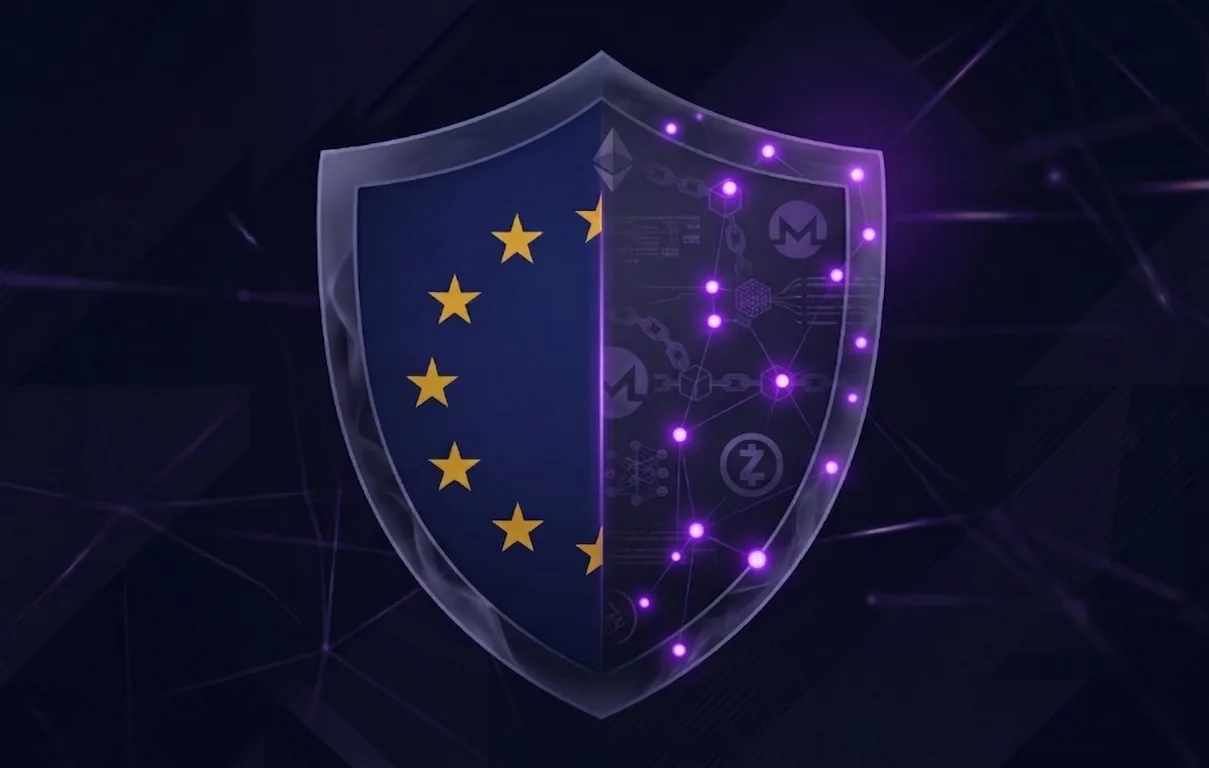
- EU exchanges are delisting Zcash, Monero, and other privacy coins under MiCA regulations
- If you hold privacy coins on an EU exchange, withdraw them to a self-custody wallet now
- You can still buy ZEC and XMR through non-custodial swap services like ChangeNOW
- Zcash has a possible path back to EU exchanges through its viewing key feature. Monero does not
What happened
MiCA (Markets in Crypto-Assets) is the EU's crypto regulation framework. It was signed into law in June 2023. Stablecoin rules took effect in June 2024. Full exchange licensing requirements became enforceable in January 2026.
As part of MiCA compliance, exchanges must ensure that all transactions on their platforms are traceable. Privacy coins are designed to make transactions untraceable. That creates a direct conflict. Exchanges chose compliance, and privacy coins got cut.
- Over 40 tokens have been removed from EU-regulated exchanges
- 14 exchanges have received full CASP (Crypto-Asset Service Provider) authorization under MiCA, including Binance (France), Kraken (Ireland), Coinbase (Ireland), and Crypto.com (France)
- Monero (XMR), Zcash (ZEC), and several smaller privacy coins have been delisted from EU platforms at most major exchanges
- Around 30 smaller platforms have exited the EU market entirely rather than pay compliance costs
On top of MiCA, there is a second regulation coming. The EU's Anti-Money Laundering Regulation (AMLR) was formally adopted in 2024 and takes full effect by July 2027. Article 79 explicitly prohibits crypto-asset service providers from handling "anonymity-enhancing coins." This is not a gray area. It is a direct, named ban on privacy coin support by any regulated EU entity.
What this means for Zcash vs Monero
MiCA treats all privacy coins the same way on paper, but the two leading privacy coins have very different architectures, and that difference matters for what happens next.
Monero is private by default. Every transaction hides the sender, receiver, and amount automatically. There is no option for a transparent transaction. This is exactly what regulators cannot work with. There is no compliance path for exchanges that want to keep listing XMR under MiCA's traceability requirements.
Zcash is optionally private. Users can choose between transparent transactions (fully visible on the blockchain, just like Bitcoin) and shielded transactions (private, using zero-knowledge proofs called zk-SNARKs). Zcash also has a feature called viewing keys that allow the holder to selectively disclose transaction details to a third party, like a regulator or auditor, without making the information public.
If you hold privacy coins on an EU exchange right now
Check whether your exchange has already announced a delisting. If it has, you will typically get a deadline (30 to 90 days) to withdraw your coins. If you do nothing, the exchange may convert your holdings to another asset or freeze them.
-
Get a self-custody wallet
You need a wallet where you control the private keys. Exchange wallets are custodial, meaning the exchange holds your coins on your behalf. Once they delist a coin, you lose the ability to withdraw it.
For Zcash, use Zodl (mobile, shielded by default) or a Ledger hardware wallet (Nano S Plus, Stax, or Flex for shielded ZEC support).
For Monero, use Cake Wallet (mobile) or Feather Wallet (desktop, Tor built in).
Set up the wallet, write down your seed phrase, and store it somewhere safe offline. Do not screenshot it. Do not store it in a notes app or cloud drive.
-
Withdraw to your wallet
On your exchange, go to the withdrawal page for ZEC or XMR. Paste your wallet's receiving address. Double-check the address. Send your full balance. The transaction should confirm within a few minutes for ZEC or up to 20 minutes for XMR.
Once the coins are in your wallet, you own them outright. No exchange can freeze, convert, or delist them.
-
Keep records for tax
Withdrawing coins from an exchange to your own wallet is not a taxable event in most EU jurisdictions. You are not selling or exchanging anything. You are moving property you already own.
However, keep a record of the withdrawal: the date, the amount, the market price at the time, and the transaction ID. You will need this if you sell later, because your cost basis (what you originally paid) determines your taxable gain.
Tax tool: Koinly handles tax reporting across 20+ countries and imports transactions from the main exchanges. It supports every major market outside the US, including most EU states, the UK, Canada, and Australia. Affiliate link. See our disclosure.
If you want to buy ZEC or XMR from the EU going forward
With most EU exchanges dropping privacy coins, your options for acquiring them have narrowed. Here are the paths that still work:
Option 1: Non-custodial swap
Buy a coin that is still listed on EU exchanges (like Bitcoin or USDT), withdraw it to a self-custody wallet, then swap it for ZEC or XMR using a non-custodial exchange service.
ChangeNOW is a registration-free swap service that supports ZEC and XMR. No account needed. You send one coin, receive another at a wallet address you provide. The swap typically takes 5 to 30 minutes.
This is the same "friction gap" approach we describe in our US Monero buying guide. The regulatory environment is different, but the mechanics are the same.
Move off the delisting path
ChangeNOW handles the swap without a regulated account. A hardware wallet keeps what you receive safe in self-custody.

Option 2: Peer-to-peer
Haveno is a decentralized peer-to-peer exchange built specifically for Monero. It connects buyers and sellers directly with no central operator. Trades are secured by a multisig escrow. No KYC required. The tradeoff is lower liquidity and slower execution.
Option 3: Non-EU exchange
Some exchanges outside the EU still list privacy coins and accept EU residents. This is a gray area that may narrow further as AMLR approaches. These platforms may not have the same protections as MiCA-licensed exchanges, and you are responsible for your own tax reporting.
What comes next
The AMLR deadline is July 2027. Between now and then, expect:
- Any remaining EU exchanges that still list privacy coins will drop them
- Non-custodial swap services and DEXs (decentralized exchanges) will see increased demand from EU users
- Zcash's viewing key feature may get tested as a compliance tool. If an exchange can demonstrate traceability through viewing keys, it could argue for re-listing ZEC under AMLR. This has not happened yet, but it is the most realistic path back
- Monero's trajectory in the EU is toward full peer-to-peer and non-custodial usage only. There is no realistic compliance path for XMR on regulated platforms under current law
Users moving to non-custodial swap services and self-custody should also think about the network layer. Your ISP logs every domain you visit, including every exchange, swap service, and wallet download page. Coin privacy protects what happens on-chain but not the connection that got you there. A tool like Proton VPN encrypts that traffic so only the fact of your connection is visible, not the content.
Common questions
Are privacy coins illegal in the EU?
No. Holding and using Zcash or Monero is legal in all EU member states. The regulations target exchanges and service providers, not individual holders.
Will Zcash come back to EU exchanges?
Possibly. Zcash has optional transparency and viewing keys that could satisfy traceability requirements. No exchange has re-listed ZEC under MiCA yet, but the technical path exists.
What happens to my coins if I do not withdraw before a delisting?
It depends on the exchange. Most give 30 to 90 days notice. After the deadline, some exchanges convert your holdings to a different asset. Others freeze the balance.
Is using a non-custodial swap like ChangeNOW legal in the EU?
Yes. Non-custodial swap services are not classified as CASPs under MiCA because they do not take custody of your funds. The regulatory status may change under AMLR, but as of April 2026 they operate legally.
Do I owe taxes when I withdraw from an exchange to my own wallet?
In most EU jurisdictions, no. Moving coins from an exchange to a wallet you control is not a disposal or exchange. However, if you swap one coin for another, that swap is typically a taxable event.