What your bank sees vs what Zcash sees
Two apps. Same person’s month. The difference is who else is reading along.
Open your banking app and you see a list of recent transactions. Open a Zcash wallet and you see the same kind of list. Both views look familiar. The difference is what happens to the data once you close the app.
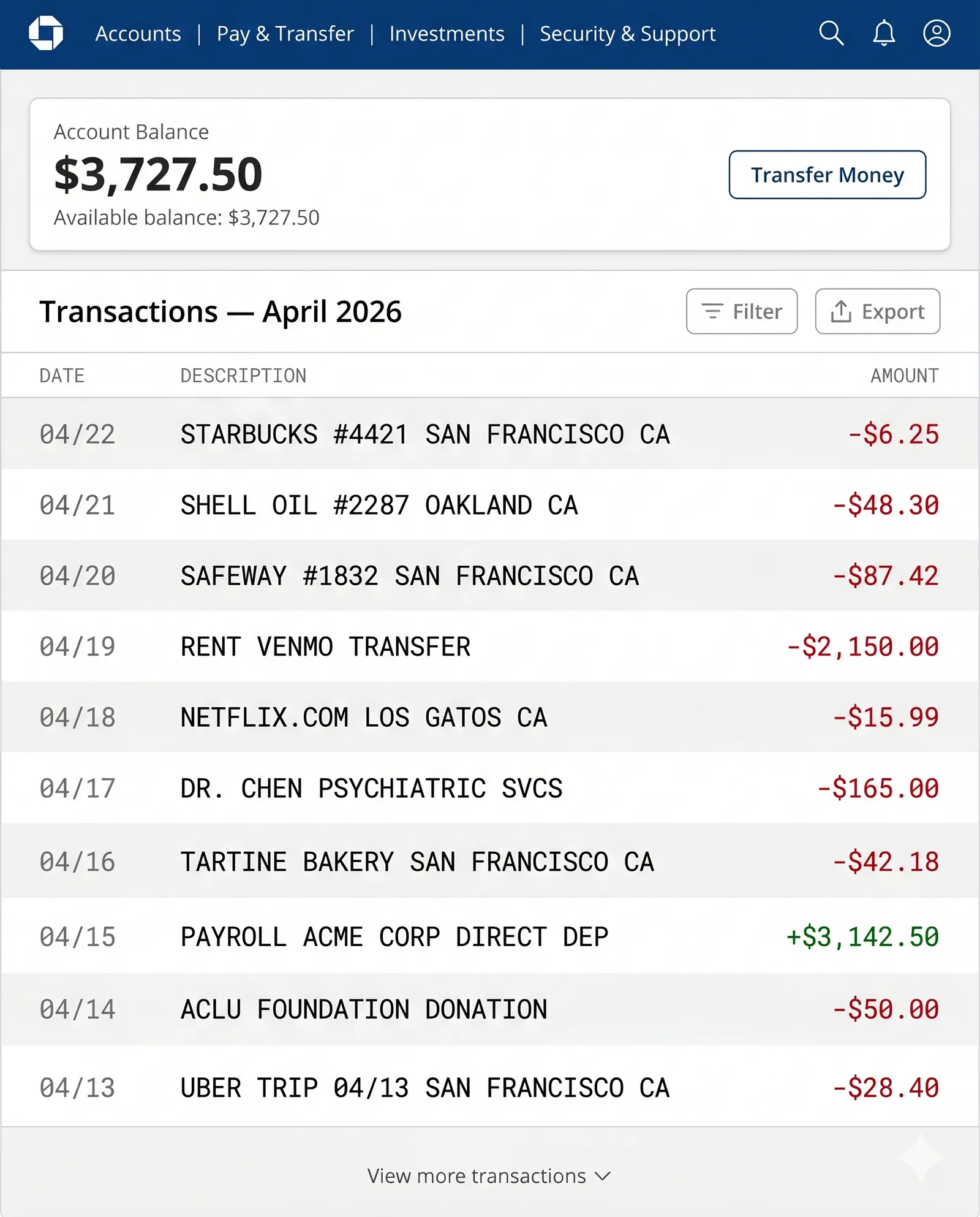
Date, merchant, location, amount. The bank sees this. So does the card network, the merchant’s payment processor, fraud vendors, marketing partners, and anyone who breaches any of those parties. Anyone who reads down the list can guess where this person lives, what they treat, what causes they support, what their week looked like.
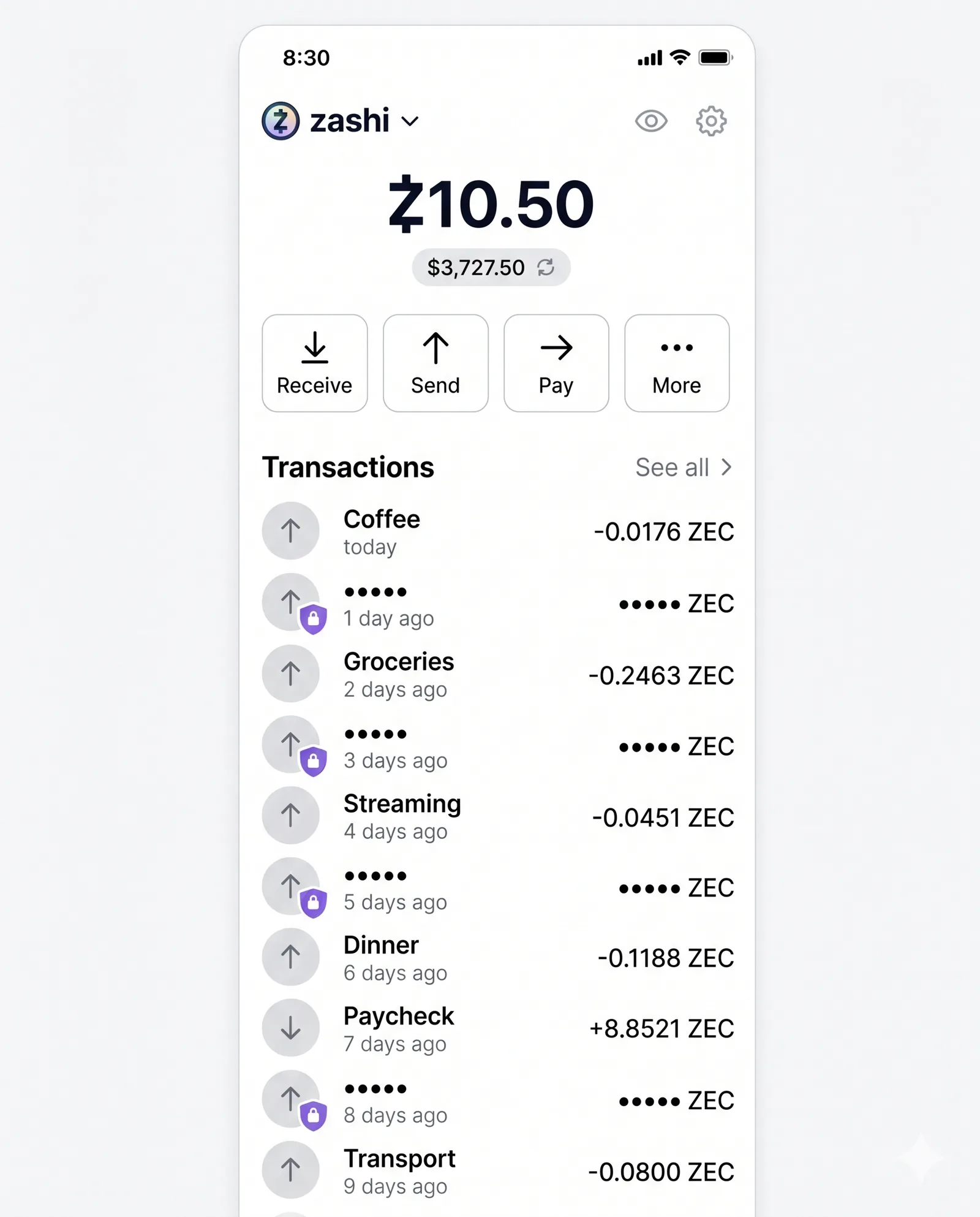
You see your activity. The bullets here illustrate what the rest of the world sees: nothing. Sender, recipient, and amount are encrypted on the chain. The wallet developer cannot read them. The network cannot read them. Anyone watching the chain cannot read them. The only person with the full view is you.
The shielded rows aren’t hidden from you
In a real Zashi wallet, you see all of your own transactions. The bullets above are an editorial illustration of what someone else would see if they tried to look. From your end, the wallet shows your full activity. From any other vantage point, it shows nothing.
That is the privacy property: not that you forget what you spent, but that nobody else gets a copy of the record.
How that works
Zcash uses a class of cryptography called zero-knowledge proofs. When you send a shielded transaction, the network checks a mathematical proof that you owned the funds and that the transaction balances. The network does not see who sent it, who received it, or how much.
This is not redaction. Redaction means somebody has the data and chooses not to display it. Zero-knowledge means the data was never exposed in the first place. There is no admin somewhere with a decryption key.
Verify it yourself on a block explorer
A block explorer is a public website that lets anyone look up activity on a blockchain. For most chains, that means you can see who sent what to whom. For Zcash shielded transactions, you cannot.
Open mainnet.zcashexplorer.app and look at the Recent Transactions list. You will see something like this:
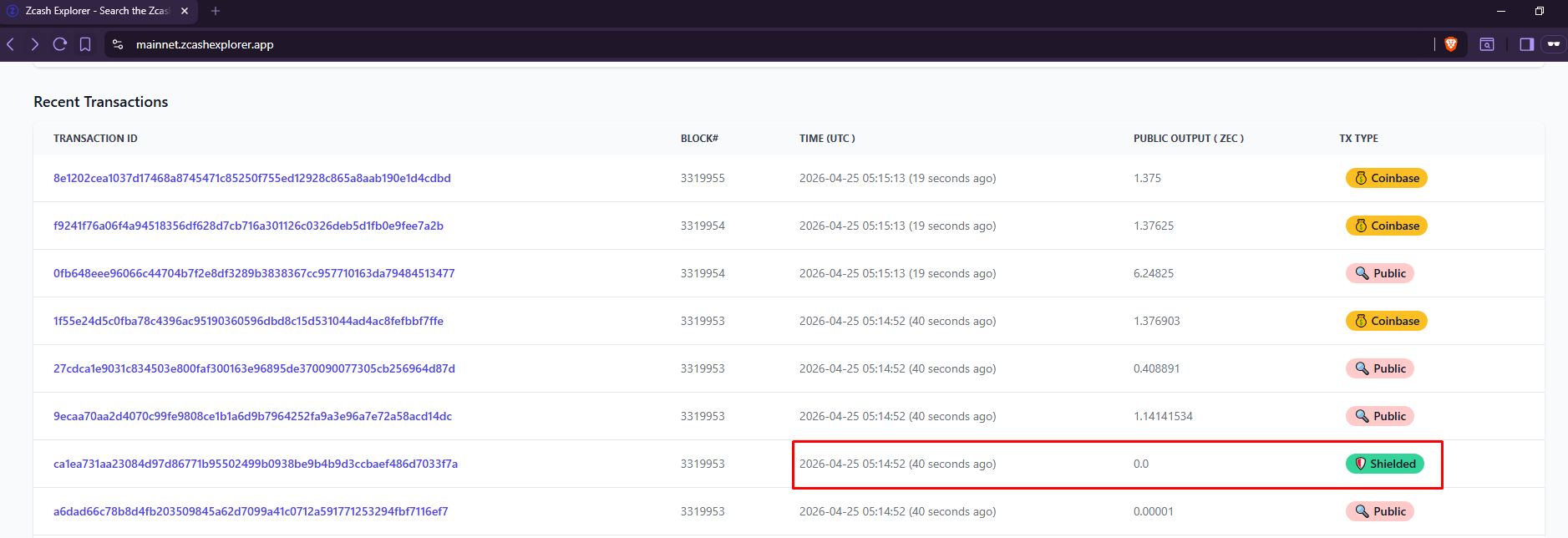
The fields you would expect on a normal blockchain explorer (sender address, receiver address, amount transferred, memo) are not there for shielded transactions. They are replaced with encrypted data the explorer cannot decode. The only public fields are the block timestamp, the network fee, and the type marker showing it was shielded.
Compare this to a Bitcoin transaction on mempool.space or an Ethereum transaction on etherscan.io. Same kind of explorer, completely different result. On those chains, every transaction is fully readable by anyone, forever.
What Zcash does not protect
The chain is one piece. The rest of the picture has to be handled separately:
- If you bought ZEC on a KYC exchange, the exchange knows you bought ZEC.
- If you connect to the network from your home IP, your ISP sees you connect.
- If your seed phrase sits in a synced cloud screenshot, your cloud account is the weak link.
Coin-level privacy is one layer. The others (connection, identity, credentials, custody) are independent and need their own treatment. The privacy stack guide walks through each of them.