Are Privacy Coins Legal? Zcash and Monero Legality by Country (2026)
Privacy coins are legal to hold in most countries. But "legal to hold" and "available to buy on a regulated exchange" are two different things. This guide covers both, for every country we track.
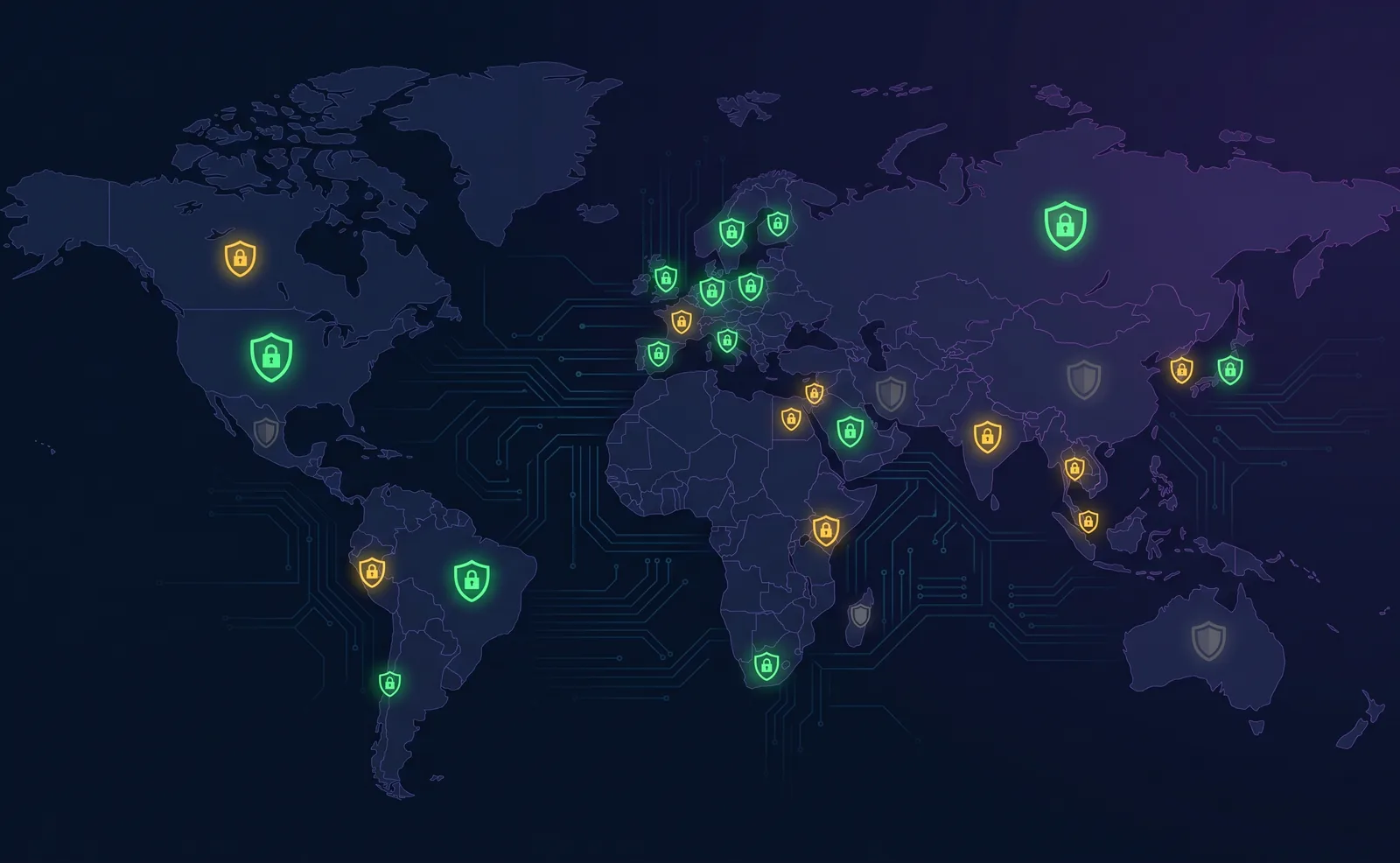
- Holding privacy coins is legal in virtually every country, including the US, EU, and UK
- Exchange access is the real restriction: governments regulate exchanges, not wallets
- Zcash has more exchange availability than Monero because of its optional transparency
- Non-custodial swap services remain accessible even where exchanges delist privacy coins
The short answer
Holding privacy coins is legal almost everywhere. Buying them on a regulated exchange is where it gets complicated.
No country has made it a crime to own Zcash or Monero. What governments have done is pressure exchanges to stop listing them. The result: the coins are legal, but the on-ramps are narrowing. How narrow depends on where you live.
United States
State-level detail: Exchange availability can vary by state due to individual state licensing requirements. Check your state guide for specifics.
European Union
ZEC: Available with caveats. Zcash is still listed on several MiCA-authorized exchanges in the EU. MiCA (Markets in Crypto-Assets), which began phased enforcement in 2024 and was fully in force by January 2026, does not explicitly ban privacy coins; it imposes licensing, disclosure, and transaction-monitoring duties on crypto service providers (CASPs). Several exchanges have voluntarily delisted or restricted ZEC in specific EU jurisdictions to reduce compliance risk, but coverage is uneven. Zcash's optional privacy (shielded addresses are a user choice) has let it remain on more EU platforms than Monero. Expect the authorized exchange list to narrow through 2026 and 2027 as the stricter AMLR regime takes effect.
XMR: Restricted. Monero's mandatory privacy makes it incompatible with the traceability duties that MiCA-regulated exchanges must meet. Major EU exchanges delisted XMR in 2024 and 2025. Holding Monero remains legal in every EU member state, but buying or selling it through a MiCA-authorized platform is not a practical option.
Country-level guides: Germany | France | Netherlands | Italy | Spain | Austria | Belgium | Poland
United Kingdom
ZEC: Available with limits. Some UK-accessible exchanges still list ZEC. The FCA (Financial Conduct Authority) has not issued a specific ban on privacy coins but has tightened crypto marketing rules and exchange registration requirements.
XMR: Restricted. Kraken dropped XMR for UK customers. Most UK-accessible exchanges have followed. UK buying guide
Canada
ZEC: Available. Listed on several Canadian-accessible exchanges. OSC (Ontario Securities Commission) regulations apply but have not specifically targeted privacy coins.
XMR: Restricted. Limited exchange availability. Similar pattern to the US. Canada buying guide
Japan
South Korea
Australia
ZEC and XMR: Restricted. No formal legislative ban, but AUSTRAC (Australian Transaction Reports and Analysis Centre) compliance requirements have led several Australian exchanges to voluntarily delist Monero. Zcash has fared slightly better due to its optional transparency. Australia buying guide
India
ZEC and XMR: Restricted. India tightened digital asset supervision in early 2026. Privacy coins face enhanced scrutiny but are not explicitly banned. Exchange availability is limited. India buying guide
Summary table
| Region | ZEC status | XMR status | Holding legal? |
|---|---|---|---|
| United States | Available | Restricted | Yes |
| European Union | Limited | Restricted | Yes |
| United Kingdom | Available | Restricted | Yes |
| Canada | Available | Restricted | Yes |
| Japan | Banned | Banned | Yes |
| South Korea | Banned | Banned | Yes |
| Australia | Restricted | Restricted | Yes |
| India | Restricted | Restricted | Yes |
For country-specific details, use the jurisdiction lookup on our homepage.
The pattern
Across every country we track, the same pattern holds:
-
Holding is legal
No country has made it a crime to own privacy coins in a personal wallet.
-
Exchange access is the pressure point
Governments regulate exchanges, not wallets. When they want to restrict a coin, they tell exchanges to delist it.
-
Zcash has more runway than Monero
Because Zcash supports transparent transactions and viewing keys, exchanges can argue for compliance. Monero's mandatory privacy offers no such argument.
-
Non-custodial alternatives exist
Even where exchanges delist privacy coins, swap services like ChangeNOW, peer-to-peer platforms, and decentralized exchanges remain accessible.
For full jurisdiction details, browse our buying guides by country and US state.
Find your jurisdiction
Legal framing changes fast. The country and US state guides cover exchange availability, regulatory posture, and tax treatment for every jurisdiction we track.
Protect your privacy. Encrypt your connection.
Your ISP logs every domain you visit. Shielded transactions protect what happens on-chain. Your ISP sees what happens before you ever open a wallet. These are two different layers, and coin privacy doesn't fix connection privacy. Proton VPN encrypts that traffic so your ISP sees only that you're connected, not what you're reading. Swiss-based, independently audited, open-source.
Common questions
Are privacy coins illegal?
In most countries, no. Owning Zcash, Monero, or other privacy coins is legal in the United States, the European Union, the United Kingdom, Canada, Australia, and most of the world. What varies is whether regulated exchanges are allowed to list them.
Is Monero illegal in the US?
No. Monero is legal to hold and use in the United States. However, most major US exchanges have delisted XMR because its mandatory privacy features conflict with exchange compliance requirements.
Is Zcash illegal in the EU?
No. Zcash is legal to hold in all EU member states. However, MiCA regulations and the upcoming AMLR (effective 2027) have caused many EU-licensed exchanges to delist ZEC.
Can I go to jail for using privacy coins?
In virtually every jurisdiction, simply holding or transacting with privacy coins is not a criminal offense. Using any cryptocurrency for illegal activities like money laundering or tax evasion is a crime everywhere.
Why do exchanges delist privacy coins?
Exchanges delist privacy coins to comply with anti-money laundering regulations that require transaction traceability. Monero's mandatory privacy makes tracing impossible. Zcash's optional privacy creates a gray area.
Where can I still buy Monero?
Monero is available through non-custodial swap services like ChangeNOW, peer-to-peer platforms like Haveno, and some international exchanges. Our Monero buying guide covers five verified methods.